A Shopify custom file delivery app is useful when the file belongs to one paid order instead of every buyer of the same product. If your store creates a different PDF, certificate, report, proof, reading, plan, spreadsheet, or private link for each customer, the delivery workflow needs to start from the Shopify order.
That is a different problem from selling a normal digital product. A product-level download app is a good fit when every buyer receives the same file immediately after checkout. Custom file delivery is for work that happens after checkout, once the merchant has reviewed the order and prepared the customer's deliverable.
The file should attach to the order, not just the product.
The first thing to check is where the app stores the file. If the app only attaches files to products or variants, it is built for same-file delivery. That model can send the wrong file when each customer needs a different result.
For custom work, the app should let the merchant open the Shopify order, choose the relevant line item, and attach the finished file or secure link there. This keeps the deliverable beside the customer, order number, fulfilment state, and support context.
Look for a post-checkout workflow.
Custom file delivery usually has a waiting period. The customer pays, then your team prepares the result. The app should support that gap instead of pretending the file is ready at checkout.
- Order received. Shopify records the customer, order number, line items, payment state, and any notes or options.
- File prepared. Your team creates, checks, exports, or selects the custom file for that customer.
- File attached. The finished file or private link is connected to the right order item.
- Customer notified. The customer receives a branded delivery email when the order is ready.
- Download kept available. Support can find the delivery context later, and the customer has a path to download again.
This workflow matters for any store where checkout is the start of production, not the end of fulfilment.
Make support visibility part of the decision.
The delivery email is only one part of the problem. A good custom file delivery workflow also helps the team answer customer questions after delivery.
Support should be able to confirm which file was attached, whether the correct order item was used, and where the customer can download again. If the team has to search a sent inbox, local folder, cloud drive, or spreadsheet, the file is still outside the Shopify workflow.
This is especially important when one order contains several custom deliverables. One file may be ready today while another is still pending. In that case, the app should make it easy to keep each deliverable tied to the correct line item instead of treating the order as one loose attachment.
Check how the customer receives the file.
Custom delivery should still feel like part of the store. A bare email attachment or raw cloud link can confuse customers because it looks separate from the purchase they made.
Look for a branded delivery email that clearly names the store, the order, and the download action. If the app supports a customer re-download path from the order-status page, that can reduce support requests when someone loses the original email.
For more on the customer experience side, read why the download email should look like your store. If you are deciding whether a product-level setup is enough, read why product-level downloads fail custom orders.
Where QuickAttach fits.
QuickAttach is being built as the Shopify app for order-specific file delivery. It is designed for merchants who need to attach a file or secure link to an individual Shopify order item after checkout, then send a branded customer download email when fulfilment is ready. For a concrete use case, see how to send custom proofs to the correct Shopify customer. For a broader buying checklist, read what to look for in a Shopify app for personalized digital downloads.
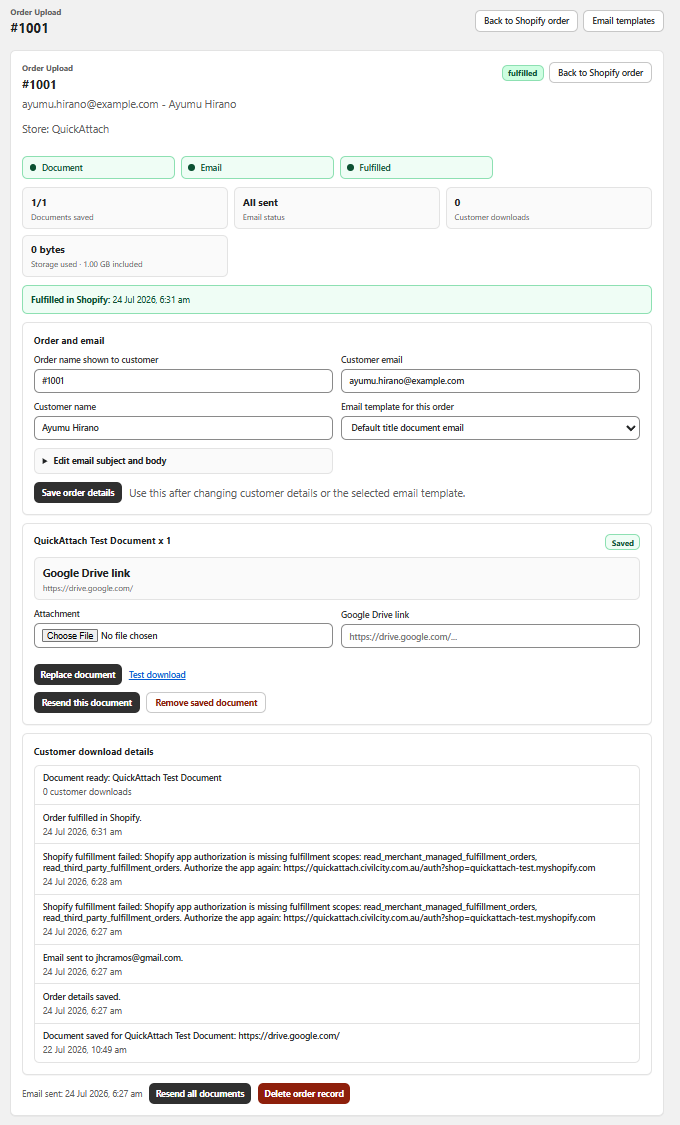
The screenshot above shows the order upload workflow: the merchant works from the Shopify order, attaches the customer's finished file to the relevant line item, and keeps the delivery context connected to the order rather than a separate inbox or folder.
That makes QuickAttach a fit for stores selling personalized reports, certificates, title documents, custom proofs, astrology or tarot readings, audits, assessments, care plans, made-to-order PDFs, spreadsheets, and private document links.
Questions to ask before choosing an app.
- Does each customer receive a different file, or does every buyer receive the same file?
- Does the finished file exist before checkout, or is it created after the order is paid?
- Can the file be attached to a specific Shopify order or line item?
- Can the customer receive a branded download email instead of a loose attachment?
- Can support see the delivery context without searching email or folders?
- Can the customer download again later from a stable order-related path?
If most answers point back to a single order, choose an order-specific file delivery workflow. For the broader setup, start with how to deliver personalized digital products after purchase on Shopify. For the exact upload step, see how to attach a file to a specific Shopify order. If you are searching by app category, read how to choose a Shopify app for customer-specific files. If you sell custom PDFs, read the Shopify custom PDF delivery workflow.
Need a custom file delivery app for Shopify?
Creating a different file, PDF, proof, certificate, or private link for every Shopify order? Install QuickAttach for an order-specific delivery workflow.
Install QuickAttach on Shopify