Shopify custom PDF delivery means sending a PDF that was prepared for one specific customer, order, or line item. The file might be a personalized report, certificate, audit, proof, reading, care plan, worksheet, or private document. The important detail is that the PDF is not the same download for every buyer.
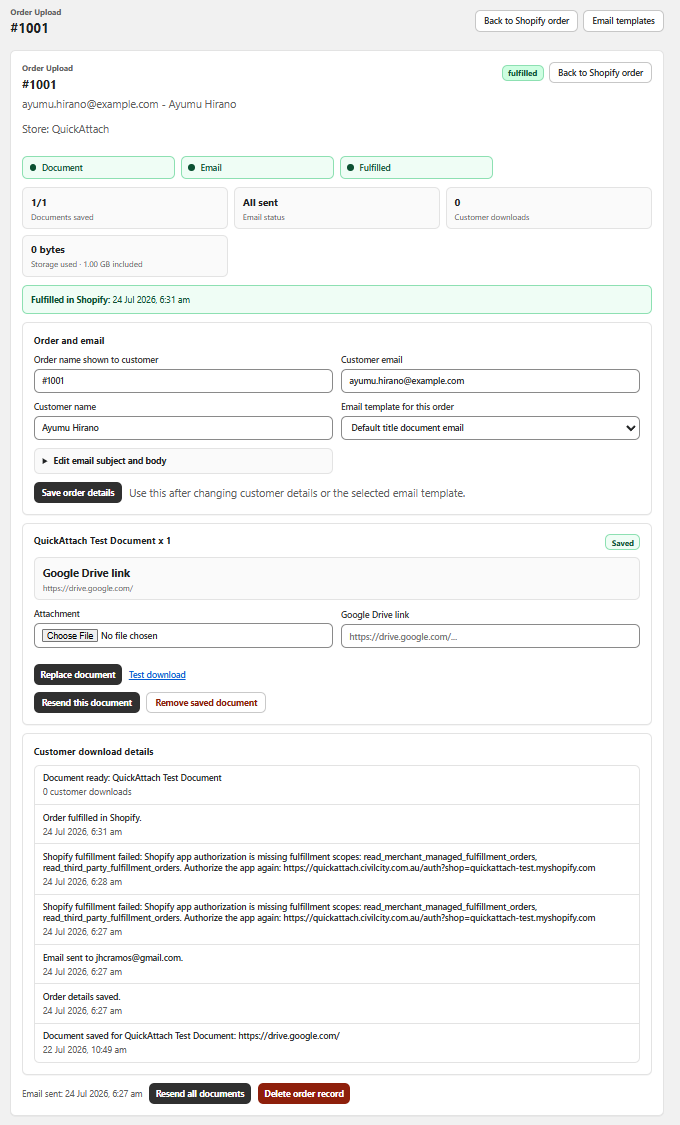
The most reliable workflow is order-specific: the customer pays, your team prepares the PDF, the final file is attached to the matching Shopify order, and the customer receives a branded download email when the order is ready. That keeps the file, customer, product, fulfillment step, and support record in one place.
Why custom PDFs break normal downloads.
A normal digital-download app is usually product-level. You attach a file to a product, and every customer who buys that product receives the same file. That is useful for ebooks, templates, stock assets, patterns, guides, or software files where the download does not change from customer to customer.
Custom PDFs are different. The deliverable is created from the customer's order details, answers, property, design brief, appointment, reading, or assessment. Sending the wrong PDF is not a small mistake; it can expose private information, create refund requests, and force support to manually repair the order.
A practical Shopify workflow for custom PDFs.
- Take the paid order. The order captures the product, customer details, notes, form answers, uploaded source files, or other inputs your team needs.
- Create the PDF after checkout. Your team prepares the finished file using the order details, then checks the customer name, order number, and product line before delivery.
- Attach the final PDF to the order. The deliverable should sit with the Shopify order or line item it belongs to, not only in a shared drive or inbox thread.
- Send the branded download email. Once the file is ready, the customer should receive a clear email from the store with a download button and order context.
- Keep a re-download path. If the customer returns later, support should be able to see what was delivered and direct the customer back to the order-related download path.
Where teams usually lose control.
Most custom PDF delivery problems come from switching systems too many times. The order is in Shopify, the draft is in a folder, the final PDF is renamed locally, the customer email is sent from an inbox, and the delivery note is remembered by whoever handled the order.
That process can work for a handful of orders. It becomes fragile when several people prepare files, when an order contains more than one custom item, or when a customer asks for another copy weeks later.
- Final and draft PDFs can be confused.
- Support may not know which file the customer received.
- A team member can send the right PDF to the wrong customer.
- The customer experience can feel less trustworthy when the file arrives as a loose attachment.
Example: a personalized assessment store.
Imagine a Shopify store selling custom business assessments. A customer buys an assessment product, fills in the required details, and expects a PDF report within two business days. The team checks the order, prepares the report, exports the finished PDF, and needs to send it only to that customer.
With a product-level download, the store cannot attach that finished report to the product without exposing it to future buyers. With manual email, the delivery record sits outside Shopify. With an order-specific workflow, the final PDF is attached to the customer's order, delivered through a branded email, and kept available for later support questions.
Where QuickAttach fits.
QuickAttach is being developed for merchants who deliver customer-specific files after checkout on Shopify. The merchant attaches a file or secure link to the relevant order item, then sends a branded download email when the order is fulfilled. The delivery context remains connected to the Shopify order.
For the broader category, read what to look for in a Shopify custom file delivery app. If you are sending one different PDF to each buyer, see how to send a unique PDF to each Shopify customer. For the upload step after checkout, read how to upload a custom PDF after a Shopify purchase.
Common mistakes.
- Treating the PDF as a product file. If the PDF belongs to one order, it should not be attached to a product that many customers can buy.
- Relying on file names alone. File names help, but they are not a delivery record. The order should show which deliverable was attached.
- Sending from a personal inbox. The customer may receive the file, but the store loses a branded delivery path and a clear re-download process.
- Skipping the final order check. Always confirm the customer, order number, and product line before releasing a custom PDF.
Key takeaways.
- Custom PDF delivery on Shopify should be order-specific when every customer receives a different file.
- Product-level download apps fit static files, not PDFs created for one buyer after checkout.
- The PDF, delivery email, re-download path, and support context should stay connected to the Shopify order.
- Manual email attachments become risky as custom order volume grows.
FAQ.
Can Shopify send a different PDF to every customer by default?
Shopify can sell the product and record the order, but a customer-specific PDF workflow usually needs an app or manual process to attach the finished file to the right order after checkout.
Should a custom PDF be attached to the product or the order?
If every customer should receive the same PDF, attach it to the product. If the PDF is created for one customer, attach it to the order or line item it belongs to.
Is it okay to send custom PDFs as email attachments?
It can work at very low volume, but it separates delivery from the Shopify order and makes support harder. A branded download email with an order-related record is usually cleaner.
What types of stores need order-specific PDF delivery?
Stores selling personalized reports, certificates, custom proofs, audits, readings, assessments, care plans, and other made-to-order documents usually need this workflow.
Deliver custom PDFs from the Shopify order.
Creating a different PDF for every Shopify customer? Install QuickAttach for an order-specific delivery workflow built around files created after checkout.
Install QuickAttach on Shopify