A Shopify app for customer-specific files should let a merchant attach the finished file or secure link to the exact order and line item it belongs to. That is the core difference from a normal digital-download app, where the same file is attached to a product and sent to every buyer.
This matters for stores selling personalized reports, custom proofs, certificates, title documents, astrology or tarot readings, assessments, care plans, private PDFs, spreadsheets, and other deliverables prepared after checkout. The customer buys through Shopify, but the file is created for that one customer.
Quick answer.
If each Shopify customer needs a different file, choose an order-specific workflow. The app should connect the file to the Shopify order item, send a branded download email when the file is ready, and keep a re-download path available for support and the customer.
Why product-level downloads are the wrong model.
Product-level digital download apps are useful when the product and the file are the same for everyone. An ebook, pattern, template, preset, or static guide can be attached to the product and delivered automatically after checkout.
Customer-specific delivery is different. The merchant cannot upload the final file before the customer has paid because the deliverable depends on the customer, the order details, or work done after purchase. Trying to force that workflow through product-level downloads creates messy workarounds:
- creating one-off products or variants for individual customers;
- emailing files manually from a shared inbox;
- pasting cloud links into order notes;
- tracking filenames in spreadsheets outside Shopify;
- searching folders when a customer asks for another copy.
Those workarounds may function at low volume, but they separate the file from the order. As soon as two customers buy the same product and need different deliverables, the product-level model stops describing the real work.
What the app should support.
A useful customer-specific file app should make the Shopify order the source of truth. The merchant should be able to open the order, see the line items, attach the finished file or link to the correct item, and trigger customer delivery when the file is ready.
For the practical upload step, read how to attach a file to a specific Shopify order. If your main deliverable is a PDF, the Shopify custom PDF delivery workflow shows how the same pattern applies to reports, certificates, and proofs.
A realistic customer-specific workflow.
Imagine a store that sells property reports through Shopify. Every customer buys the same report product, but each final PDF contains different property details. The team receives the order, prepares the report, checks it, then sends it to the customer.
In a manual workflow, the file may live in Google Drive, the delivery email may live in a staff inbox, and the Shopify order may only say "fulfilled". Later, support has to reconstruct what happened from filenames and sent messages.
In an order-specific workflow, the steps are cleaner:
- The customer places the Shopify order.
- The merchant prepares the customer-specific PDF, document, proof, report, or link.
- The finished deliverable is attached to the relevant Shopify order item.
- The customer receives a branded download email when the order is ready.
- The order keeps the delivery context so support can confirm what was sent.
This same structure works for personalised readings, certificates, custom product proofs, audits, assessments, care plans, made-to-order PDFs, and private document links. The details change, but the operational need is the same: keep the deliverable with the order.
How to evaluate apps before launch or migration.
Before choosing a delivery app, map your real fulfilment process. If the same file can be sent to every buyer immediately after checkout, a product-level app may be enough. If someone on your team has to create, review, export, or select a unique file for each customer, you need order-level delivery.
Ask these questions:
- Does the final file exist before checkout?
- Can two customers buying the same product receive different files?
- Does one Shopify order ever contain several custom deliverables?
- Can support confirm which file was sent without opening email or folders?
- Does the customer have a branded path to download again?
- Can the app handle secure links as well as uploaded files if your workflow needs them?
If most answers point back to a specific order, look for an app built around customer-specific files rather than static product downloads. For a broader selection checklist, see what to look for in a Shopify custom file delivery app. To reduce operational risk, read how to prevent sending the wrong PDF to a Shopify customer.
Where QuickAttach fits.
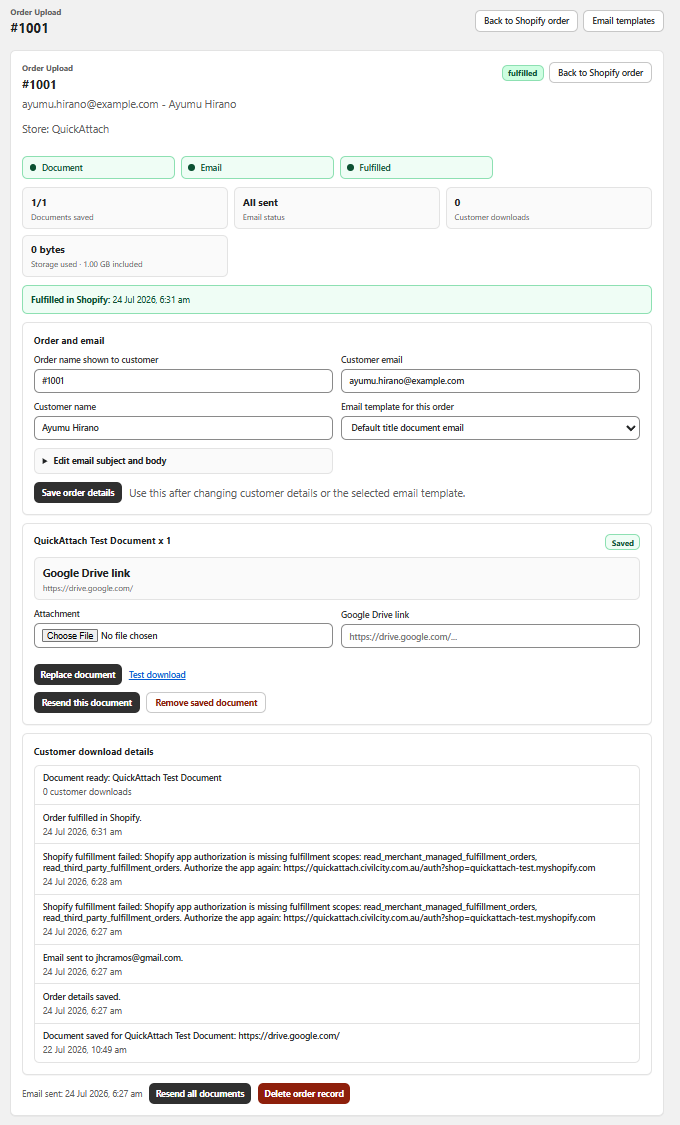
QuickAttach is being built for Shopify merchants who create a different file or secure link for each customer after checkout. The app is designed to attach customer-specific files to Shopify order items, deliver them through a branded customer email when fulfilment is ready, and keep the download context associated with the order.
The screenshot above shows the product direction: the merchant works from the Shopify order, uploads or links the finished customer file, and keeps the delivery record connected to the line item. Until the app store launch, the right next step is joining early access.
Need customer-specific file delivery on Shopify?
Selling custom PDFs, proofs, certificates, reports, readings, or private documents? Install QuickAttach for an order-specific delivery workflow built around the Shopify order.
Install QuickAttach on Shopify