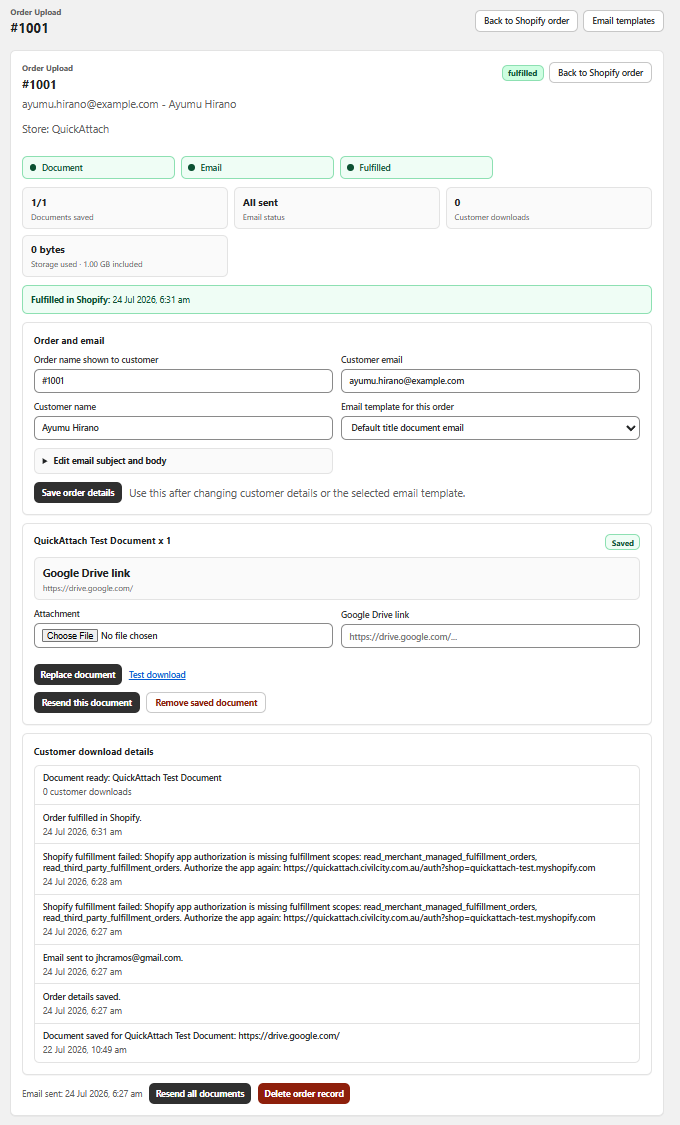
To deliver personalized digital products on Shopify, treat the finished file as an order-specific deliverable. The customer buys first, your team creates or selects the right file, and the delivery record should stay attached to the Shopify order or line item.
That is different from a standard digital-download workflow. A product-level download works when every buyer receives the same template, ebook, pattern, or ZIP file. Personalized reports, certificates, readings, proofs, assessments, plans, and customer-specific PDFs need a post-checkout workflow.
Why the usual digital-download setup breaks.
The common setup is simple: attach a file to a Shopify product, then send that file automatically after purchase. That is clean for same-file products. It is risky for personalized work because the file does not exist yet, or it should only go to one customer.
The operational problem is not only sending the file. It is knowing which file was prepared, who checked it, which order item it belongs to, whether the customer was emailed, and where support can find the delivery later.
A better workflow for personalized Shopify files.
- Take the order in Shopify. Let checkout capture the customer, order number, line items, and payment state.
- Create or select the personalized file after checkout. This might be a PDF report, certificate, custom proof, private media file, archive, or secure external link.
- Attach the deliverable to the specific order item. Keep the file beside the line item it belongs to, especially when one order contains several custom products.
- Send the customer a branded delivery email. The message should make the store, order, and download action clear.
- Keep a re-download path. If the customer loses the email, support should not have to resend the file manually from a personal inbox.
What to avoid.
Do not run personalized delivery from a loose folder plus a human memory system. Similar filenames, repeated customer names, and multi-file orders make that fragile fast.
- Do not send files from a personal inbox with no Shopify order record.
- Do not use one product download when each buyer needs a different result.
- Do not make support search email threads to confirm what was delivered.
- Do not expose a raw external link unless its sharing settings are correct for the intended customer.
Where QuickAttach fits.
QuickAttach is built for this order-specific gap. It lets a Shopify merchant attach a unique file or secure external link to each order item, send a branded customer email, and keep delivery context connected to the order workflow.
For stores selling personalized reports, tarot or astrology readings, certificates, title documents, proofs, audits, assessments, care plans, or made-to-order PDFs, this gives the team a shared place to see what is ready and what has been sent.
If your current process is still email plus folders, read more about why product-level downloads fail custom orders and the Shopify workflow for made-to-order digital products. If you sell readings, see this practical workflow for delivering astrology reports through Shopify. If you are comparing app options, use the Shopify custom file delivery app checklist. For the specific case of sending a different PDF per customer, see how to send a unique PDF to each Shopify customer. To understand why the standard download model breaks for custom work, read why custom digital products need a post-checkout workflow.
Example: one customer, one finished PDF.
A customer buys a personalized report. The report is not ready at checkout, because your team has to prepare it from the customer’s order details. Once it is finished, the file should be attached to that order, delivered from your brand, and visible to support later.
That same pattern applies to certificates, property documents, artwork proofs, commissioned files, and private assessments. The customer sees a clean post-purchase experience. Your team keeps the delivery record in one place.
Deliver personalized files from the order, not the inbox.
Creating a different file for every Shopify customer? Install QuickAttach for an order-specific delivery workflow.
Install QuickAttach on Shopify