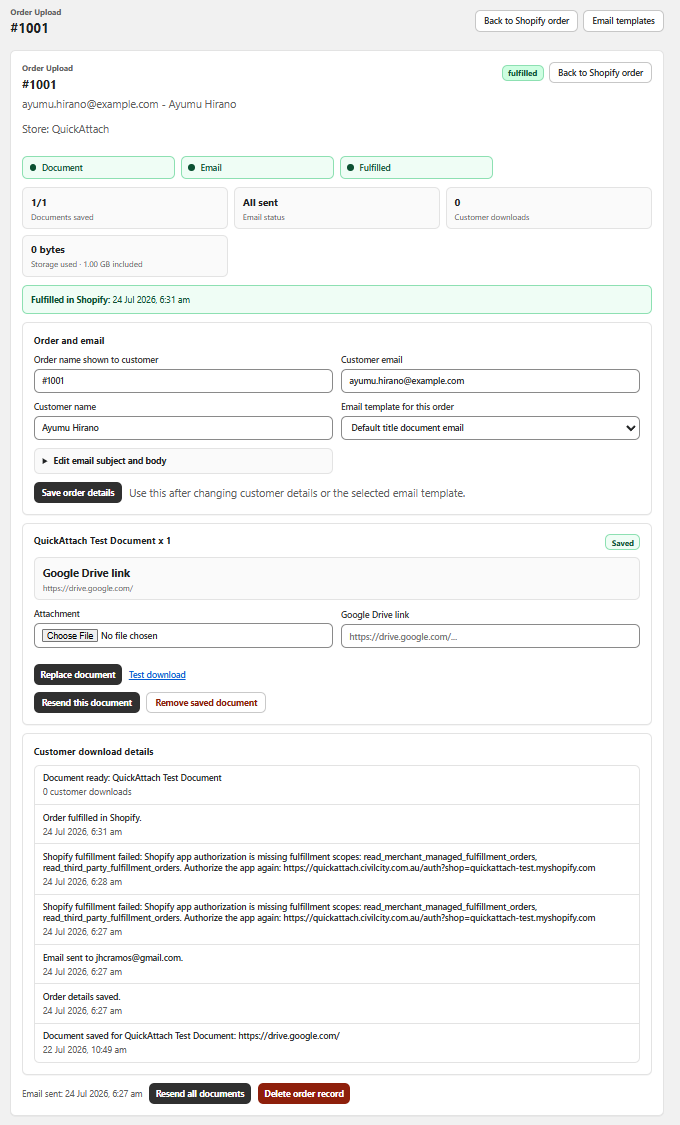
The best Shopify workflow for made-to-order digital products is simple: take the paid order, create the customer-specific file, attach the finished file to the right Shopify order or line item, then send a branded download email when the order is fulfilled.
That sounds obvious until the store starts growing. A merchant selling personalized reports, custom PDFs, proofs, readings, certificates, or private documents quickly learns that the file cannot be treated like a normal product download. The deliverable belongs to one order and one customer.
Why normal digital downloads do not fit made-to-order work.
Traditional digital download apps are built for products where the file already exists. A merchant uploads a pattern, template, ebook, or stock asset to the product. Every buyer receives the same file automatically after checkout.
Made-to-order products work differently. The customer pays first, then your team produces something specific for that order. The file might include customer details, a custom recommendation, a reviewed document, a one-off design proof, or a private result that no other customer should receive.
If that file is delivered from email or a shared folder, Shopify stops being the source of truth. The order says the customer paid, but it does not clearly show which file was prepared, sent, or made available for re-download.
A practical made-to-order delivery flow.
Use Shopify for the sale, then keep the file workflow tied to the order:
- 1. Sell the service or digital product. The customer buys the product in Shopify and provides the details needed to create the deliverable.
- 2. Review the order. Your team checks the order, customer notes, product options, and any intake details before starting the work.
- 3. Create the file. Prepare the PDF, report, certificate, proof, spreadsheet, reading, or private link for that specific customer.
- 4. Attach it to the order. Connect the finished file or secure link to the Shopify order or line item it belongs to.
- 5. Fulfill and notify. Send the customer a branded download email when the custom file is ready.
- 6. Keep a re-download path. Make sure the customer and support team can return to the order later instead of searching old emails.
This is the difference between a folder-based process and an order-specific process. The order, customer, product, file, fulfillment message, and support record stay connected.
What to track before the file is ready.
Most made-to-order delivery mistakes happen before fulfillment. The team is juggling paid orders, work-in-progress files, draft versions, final versions, and customer questions. A reliable workflow should make three states clear:
- Waiting to prepare. The order is paid, but the custom file has not been started or finished.
- Ready to deliver. The final file has been checked and attached to the correct order.
- Delivered. The customer has been sent the branded download email and has a stable place to download again.
Those states matter because a customer may ask where their file is before it is ready. Support needs an answer without digging through email, Slack, local folders, or private notes.
For more on this operational gap, read why custom digital products need a post-checkout workflow.
A realistic example: custom property report store.
Imagine a Shopify store selling made-to-order property reports. A customer buys a report on Monday and enters the property details at checkout. The team researches the property, creates the PDF, checks it, and finishes the file on Wednesday.
With a manual process, someone emails the PDF attachment to the customer and maybe adds a private note to the Shopify order. If the customer comes back next month asking for another copy, support has to search the sent folder or ask the person who prepared the report.
With an order-specific process, the finished PDF is attached to the Monday Shopify order. Fulfillment triggers a branded customer email. The order keeps the delivery context, and the customer has a re-download path tied to the purchase.
The same pattern works for astrology reports, tarot readings, custom care plans, design proofs, certificate requests, audit documents, and any made-for-one-customer PDF.
Where QuickAttach fits.
QuickAttach is being built for this exact made-to-order workflow. Instead of treating the file as a product-level download, the merchant attaches a file or secure link to the relevant Shopify order item after checkout. When the order is ready, the customer receives a branded download email, and the delivery remains connected to the order.
That makes QuickAttach useful when every customer gets a different deliverable, when one order can include more than one custom file, or when support needs to confirm what was sent without leaving Shopify.
For the broader category guide, read how to deliver personalized digital products after purchase on Shopify. For the exact upload step, see how to attach a file to a specific Shopify order. If the made-to-order file is a PDF, read the Shopify custom PDF delivery workflow.
Before you choose a workflow.
Ask four questions before deciding how to deliver made-to-order digital products through Shopify:
- Does every buyer receive the same file, or does each order need a different file?
- Does the file exist before checkout, or is it created after the order is paid?
- Can support see what was delivered without searching email or folders?
- Can the customer download again from a branded path if they lose the email?
If every answer points back to the individual order, use an order-specific file delivery workflow rather than a product-level download setup.
Deliver made-to-order files from the Shopify order.
Creating a different PDF, report, proof, or private file for every Shopify order? Install QuickAttach for an order-specific delivery workflow built around custom files created after checkout.
Install on Shopify