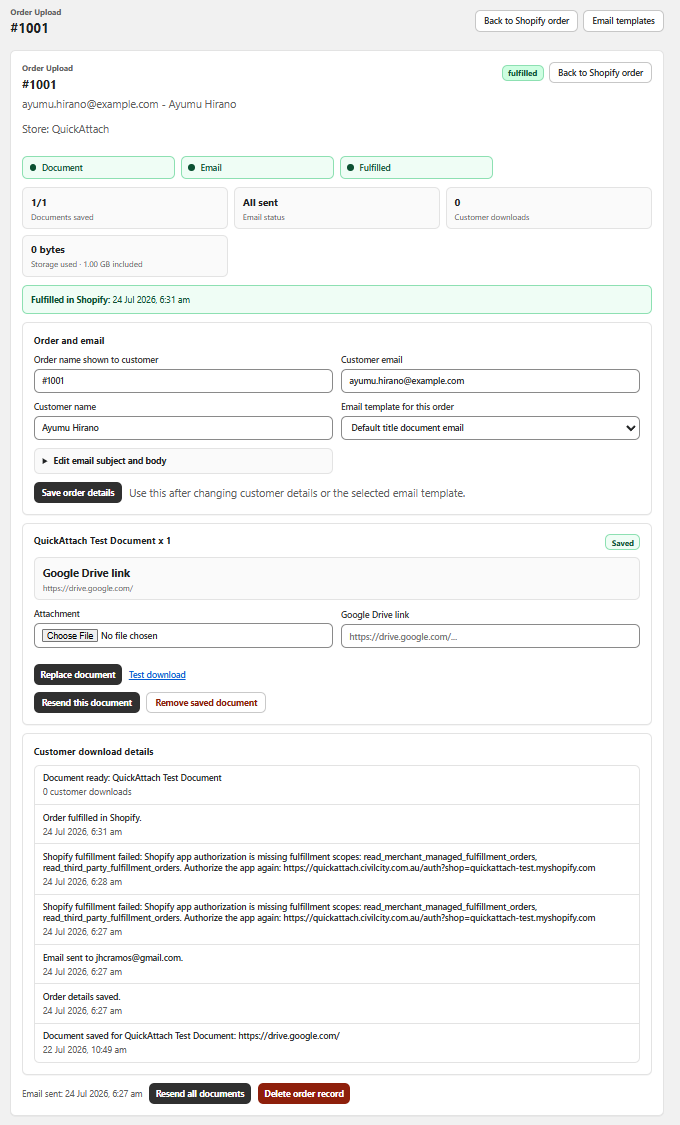
To upload a custom PDF after a Shopify purchase, use the order as the source of truth: open the paid order, prepare the PDF, check the customer and line item, attach the finished file to that order, and send the customer a branded download email when the file is ready.
That workflow matters because a custom PDF is usually not available at checkout. It might be a certificate, property document, personalized report, proof, reading, care plan, audit, or assessment created from the customer's details. If every buyer receives a different PDF, the file belongs to the order, not the product.
Why the normal digital download setup does not fit.
Many digital-download tools start from the product page. The merchant attaches a file to a product, and customers who buy that product receive the same file automatically. That is useful for static ebooks, guides, templates, or patterns.
A custom PDF after purchase is different. The final file is created only after the order exists. If the merchant tries to force that workflow into a product-level download, the team can end up with duplicate products, confusing file names, manual overrides, or risky email attachments.
A practical workflow for uploading the PDF.
- Confirm the paid order. Use the Shopify order number, customer name, product, and any order notes or form answers as the starting point.
- Create the finished PDF. Prepare the report, proof, certificate, or document outside Shopify, then export the final version with a clear file name.
- Match the file to the order item. Check that the PDF belongs to the right customer and product line before upload. This is especially important when one order contains several custom deliverables.
- Attach the PDF to the order. The finished file should sit with the order or line item it belongs to, so support can later see what was sent.
- Send the branded download email. Instead of sending a loose attachment from an inbox, send the customer a store-branded message with the download path and order context.
- Keep a re-download path. Customers often need another copy later. A clear order-related download path reduces manual support work.
Where manual email starts to break.
Sending one PDF manually is simple. Sending dozens of customer-specific PDFs across several team members is where mistakes appear. A PDF can be attached to the wrong email thread, a draft can be sent instead of the final file, or support can lose track of which customer received which version.
Manual email also makes the customer experience feel less connected to the store. The buyer purchased through Shopify, but the finished deliverable arrives as a separate attachment with no persistent download path.
- The order may not show what file was delivered.
- The customer's download history can be hidden in an inbox thread.
- Support has to search folders before answering a simple re-download request.
- Multi-file orders become hard to manage when some PDFs are ready before others.
Example: a custom certificate store.
Imagine a Shopify store selling customer-specific certificates. A customer buys a certificate product, provides details during checkout or in a follow-up form, and expects the finished PDF after the team checks the information.
The certificate should not be attached to the product for every future buyer. It should be uploaded to the customer's order, connected to the relevant line item, and delivered when the certificate is ready. If the customer asks for another copy later, the team should not need to search a shared drive and guess which file was sent.
Where QuickAttach fits.
QuickAttach is being built for Shopify merchants who need to attach a customer-specific file or secure link after checkout. The merchant uploads the finished PDF to the relevant order item, then sends a branded download email when the file is ready. The file, email, customer, and order stay connected.
For the broader category, read how to deliver personalized digital products after purchase on Shopify. If each customer receives a different PDF, see how to send a unique PDF to each Shopify customer. For a deeper PDF-specific workflow, read the Shopify custom PDF delivery workflow.
Checks before sending the PDF.
- Customer: Does the name or company match the Shopify order?
- Order number: Does the file name or internal note match the correct order?
- Line item: If the order contains multiple products, is this PDF attached to the right item?
- Final version: Is the file the approved export, not a draft?
- Delivery path: Will the customer have a clear way to download the PDF again?
FAQ.
Can Shopify upload a custom PDF to an order by default?
Shopify records the order, customer, and products, but merchants usually need an app or a manual process to attach a finished customer-specific PDF to that order after checkout.
Should the PDF be sent immediately after purchase?
Only if the PDF already exists and every customer should receive the same file. If the PDF is created for one customer, send it when the finished version is ready.
Is a custom PDF different from a digital product?
It can still be a digital product, but the delivery model is different. A static digital product is product-level. A custom PDF is order-specific.
Upload custom PDFs to the order they belong to.
Creating PDFs after Shopify checkout? Install QuickAttach for an order-specific delivery workflow built around customer-specific files.
Install QuickAttach on Shopify