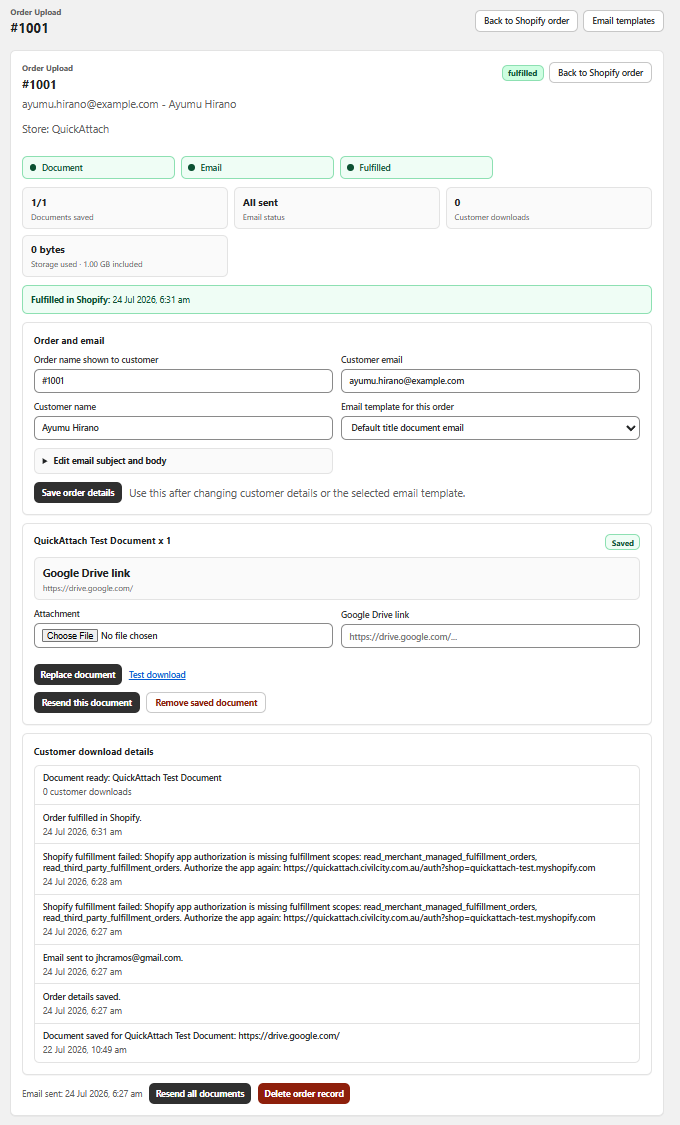
To track which file was sent to a Shopify customer, keep the file, customer, order number, line item, delivery email, and re-download path connected in one order-specific record. If the file is only tracked in email, a folder, or a spreadsheet, support has to reconstruct the delivery history every time a customer asks a question.
This is a common problem for Shopify stores selling personalized reports, certificates, proofs, readings, audits, care plans, title documents, and made-to-order PDFs. The customer may buy a normal Shopify product, but the final deliverable is prepared after checkout and belongs to that one order.
Why inboxes and folders lose the delivery record.
Manual delivery usually feels manageable at the start. A team member creates the PDF, uploads it to a folder, sends the customer an email, and marks the order fulfilled. The issue appears later, when the customer asks for another copy, says they received the wrong file, or needs support to confirm what was sent.
In that moment, the Shopify order often does not contain the answer. The record is split across several places:
- The finished file sits in Google Drive, Dropbox, or a local folder.
- The delivery email lives in a team inbox or an individual staff inbox.
- The order note says "sent" but not which file was sent.
- The customer may have bought several custom items in the same order.
- A revised file may have replaced the first version without a clear trail.
The result is slow support and higher risk. Your team has to search by customer name, order number, filename, date, and product before they can answer a simple question.
What a useful Shopify file delivery record should show.
A useful delivery record is not just a note that says a file was sent. It should make the file history understandable to the next person who opens the order.
For each customer-specific deliverable, the record should show:
- which Shopify order and line item the file belongs to;
- the filename or secure link that was attached;
- whether the file is still being prepared, ready, or delivered;
- when the customer download email was sent;
- where the customer can re-download the file;
- which item still needs work when an order contains multiple deliverables.
That structure lets support answer from the Shopify order instead of opening five separate tools. It also helps operations spot unfinished work before a customer has to ask.
Use the order item, not just the order note.
Order notes can help, but they get messy when one order contains more than one custom file. A customer might buy a birth chart report, a compatibility add-on, and a gift certificate in the same checkout. One file may be ready today and another tomorrow.
In that case, the delivery record needs to follow the line item. The team should be able to see that item A has its final PDF, item B is still pending, and item C was delivered by a secure link. This is the difference between a general fulfillment note and an order-specific file workflow.
For the multi-item version of this problem, read how to manage several custom files in one Shopify order. If the core issue is matching the file to the order in the first place, see how to attach a file to a specific Shopify order.
A practical workflow for tracking sent files.
A cleaner workflow starts before the customer asks for support. The goal is to make the delivery record obvious while the team is doing the work.
- Keep the order open while the file is being prepared. Avoid marking the order complete before the custom deliverable exists.
- Name the file with a customer or order reference. A clear filename reduces confusion, but it should not be the only tracking system.
- Attach the file or link to the correct order item. Tie the deliverable to the Shopify context where payment, customer details, and fulfillment already live.
- Send the branded download email from the delivery workflow. The email should be part of the record, not a separate manual step.
- Keep the customer re-download path connected to the order. This reduces repeat support requests when a customer loses the original email.
- Check the order before resending anything. Support should be able to confirm the delivered file without searching an inbox.
This workflow is especially useful when files are private, high-value, or easy to mix up. The more similar the deliverables look, the more important the order record becomes.
Example: customer-specific certificates.
Imagine a store that sells certificates or ownership documents through Shopify. Each customer buys the same product, but the finished certificate contains customer-specific details. A customer contacts support two months later and asks for another copy.
If delivery happened through email alone, support has to search sent mail, match the certificate filename, check whether a revised version was sent, and decide which attachment is safe to resend. If a staff member used a personal inbox, the trail may be even harder to follow.
With an order-specific record, support opens the Shopify order, checks the attached file or link for the relevant line item, and sends the customer back to the proper download path. The order becomes the shared source of truth.
Where QuickAttach fits.
QuickAttach is being developed for merchants who create customer-specific files after checkout on Shopify. The app is designed to let a merchant attach a unique file or secure link to the right order item, deliver it through a branded customer email when fulfillment is ready, and keep the delivery context associated with the order.
If your main risk is sending the wrong document, read how to prevent sending the wrong PDF to a Shopify customer. For the broader workflow, start with how to deliver personalized digital products after purchase on Shopify. If the operational gap is recordkeeping, see how to keep a delivery record on the Shopify order. You can also see the product flow on How QuickAttach works.
Keep custom file delivery visible on the order.
Need to track which file or link went to each Shopify customer? Install QuickAttach for an order-specific delivery workflow built around the customer, order item, and download record.
Install QuickAttach on Shopify