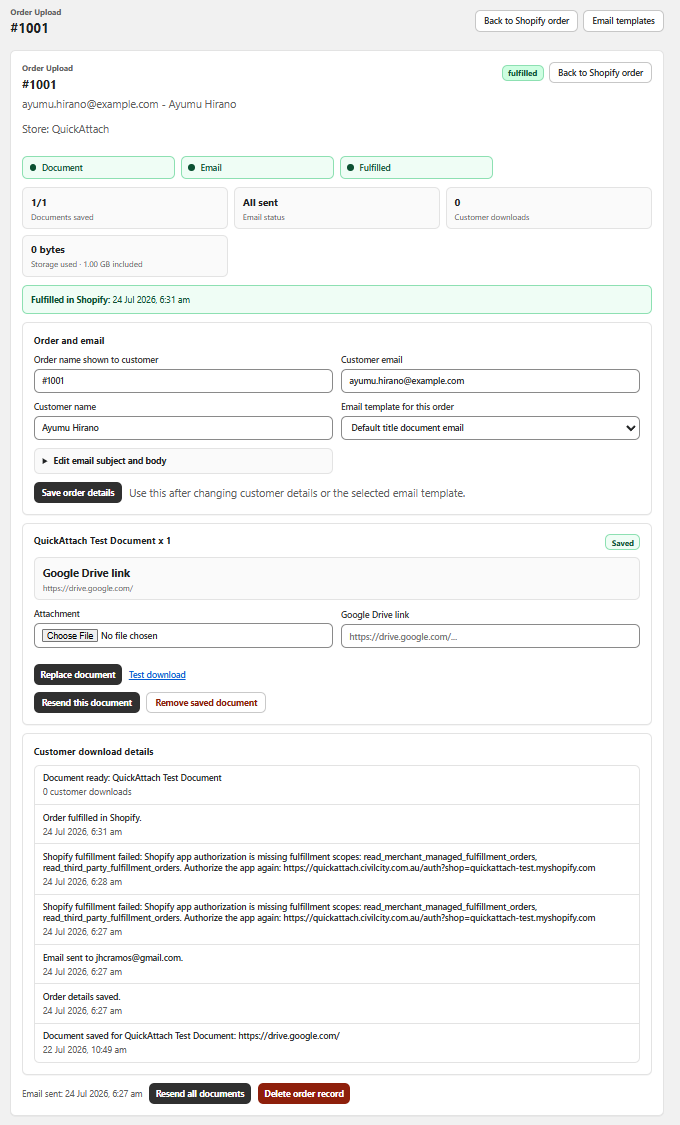
To keep a delivery record on a Shopify order, tie each customer-specific file or secure link to the order and line item it belongs to. The record should make it clear which file was prepared, whether it was delivered, and where the customer can access it again.
This matters when the file is created after checkout. Stores selling personalized reports, certificates, proofs, readings, audits, care plans, title documents, or made-to-order PDFs cannot rely on a product-level download alone. The product may be the same for every buyer, but the finished deliverable belongs to one customer and one order.
Why a sent email is not a delivery record.
Email is useful for notifying the customer, but it is a poor source of truth for fulfillment. Once a custom file is sent from an inbox, the record often drifts away from Shopify. A future support question turns into a search across sent mail, folders, filenames, team notes, and order history.
The problem gets worse when a store has more than one person preparing files. A team member may upload a revised PDF, another person may send the customer a link, and support may only see a vague note that says "sent." That is not enough when the customer asks which version they received or when a private document needs to be resent carefully.
- The Shopify order does not show the exact file or link that was delivered.
- The delivery email can sit in a personal inbox instead of a shared workflow.
- Support has to search by customer name, order number, filename, and date.
- Multiple custom items in one order are hard to track with a single note.
- A replacement file can overwrite the old context without a clear trail.
A useful delivery record keeps the operational answer where the team already looks: the Shopify order.
What the Shopify order should tell your team.
A custom-file order record should answer practical support and operations questions without detective work. If a team member opens the order six weeks later, they should be able to understand the delivery state quickly.
At minimum, the record should show:
- which order and line item the file belongs to;
- the filename or secure link attached to that item;
- whether the deliverable is pending, ready, delivered, or replaced;
- when the customer download email was sent;
- whether other items in the same order are still waiting;
- where the customer can re-download the delivered file.
This does not need to be complicated. The important part is that the file, customer, order item, email, and download path stay connected instead of being scattered across separate tools.
Use line items for multiple custom deliverables.
Many merchants start by adding a note to the overall order. That can work for a single file, but it breaks down when one checkout contains several custom deliverables.
Imagine a customer buys a certificate, a supporting document, and a custom summary. The certificate may be ready first, the supporting document later, and the summary tomorrow. If the order only says "file sent," nobody knows which file. If each deliverable is tracked against the relevant line item, the order becomes readable.
For this reason, line-item context matters. A delivery record should not only say that the order has a file. It should show which purchased item has which file attached, and which items still need work. For the broader multi-item process, read how to manage several custom files in one Shopify order. If one item is ready before the rest, see how to handle partial file delivery on Shopify.
A practical delivery-record workflow.
Use this workflow when the deliverable is created after checkout and needs to remain visible on the Shopify order:
- Keep the order open while the custom work is prepared. Avoid marking the order complete before the deliverable exists.
- Name the file with an order reference. A clear filename helps, but do not rely on filenames alone as the tracking system.
- Attach the file or secure link to the matching order item. The attachment should live with the Shopify context, not only in a folder.
- Send the customer message from the delivery workflow. The email should be part of the record, not a separate manual step.
- Leave pending or replaced items visible. A future team member should know whether anything is still being prepared or has changed.
- Use the order record before resending files. Support should confirm the current file from Shopify before sending another copy.
The goal is not paperwork for its own sake. The goal is to prevent the same order from being reconstructed repeatedly by different people.
Example: certificates and customer documents.
Consider a Shopify store that sells customer-specific certificates or document packets. Each buyer purchases the same product, but the final document contains details unique to that customer. A month later, the customer asks for another copy.
If delivery happened through email alone, support has to find the original message, confirm the attachment was the final version, check whether a replacement file was sent, and decide which document is safe to resend. That is slow, and it creates room for mistakes.
With an order-based delivery record, support opens the Shopify order, checks the attached file or link for the relevant item, and points the customer to the right download path. The answer lives on the order instead of inside someone's memory.
Where QuickAttach fits.
QuickAttach is being developed for Shopify merchants who create customer-specific files after checkout. The app is designed to let a merchant attach a file or secure link to the right order item, send a branded customer download email when fulfillment is ready, and keep delivery context associated with the Shopify order.
If your main concern is confirming what went to a customer, read how to track which file was sent to a Shopify customer. If the risk is sending the wrong document, read how to prevent sending the wrong PDF to a Shopify customer. For the foundation, start with how to attach a file to a specific Shopify order. You can also see the product flow on How QuickAttach works.
Make the Shopify order your delivery record.
Creating a different file, PDF, certificate, or private link for every order? Install QuickAttach for an order-specific workflow that keeps the file, customer, and delivery context connected.
Install QuickAttach on Shopify