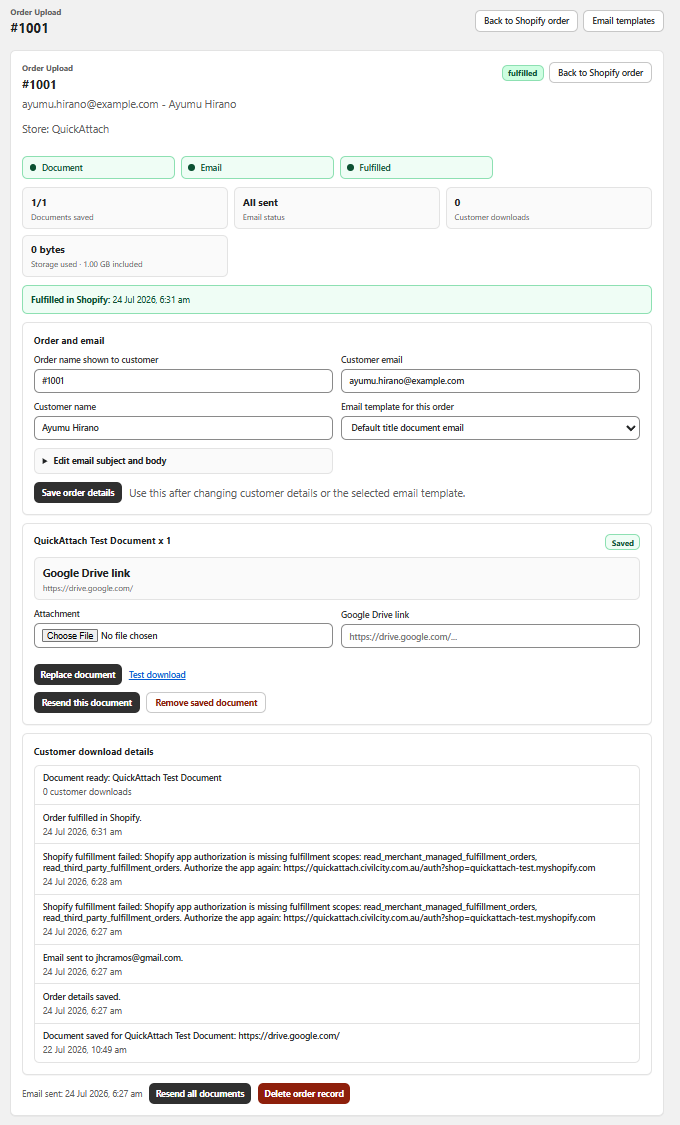
Short answer: treat a revised custom file as an update to the original order deliverable, not as an unrelated email attachment. Confirm the order and customer first, create a clearly named replacement, check it, attach it to the matching order item, and send one replacement notification that tells the customer which version is current.
This matters for stores selling reports, certificates, proofs, readings, audits, care plans, and made-to-order PDFs. The first file may contain a typo, missing page, incorrect name, or customer-requested change. A second email sent from a loose folder can solve today's problem while creating tomorrow's support mystery.
Why revisions get messy in email and folders.
Email folders store messages, not a dependable relationship between a Shopify order, its line item, the delivered file, and the current revision. Filenames such as final.pdf, final-2.pdf, and final-revised.pdf are invitations to guess. A teammate can resend the old attachment, overwrite a file without telling support, or send a corrected document to the wrong customer.
- The original and replacement are not clearly distinguished.
- The order does not show which version is current.
- Support cannot quickly confirm what the customer received.
- The customer has to search multiple emails for the latest file.
A safer replacement workflow.
- Identify the order. Start from the customer request or internal task, then verify the Shopify order number, email address, and line item. Do not rely on a first name or filename alone.
- Define the change. Write a short internal note such as “corrected property address” or “added page 4.” This gives the reviewer something concrete to check.
- Create a traceable filename. Include the order reference and a revision marker, for example
order-1048-report-v2.pdf. Avoid calling every export “final.” - Review before upload. Check the customer name, order-specific details, page count, links, and revision. A second person should review sensitive documents where practical.
- Replace the order-linked deliverable. Attach the current file or link to the same Shopify order item. Keep the delivery context with the order rather than starting a new manual thread.
- Notify the customer clearly. Say that an updated file is available, identify the order, explain the correction briefly, and provide the current download action. Tell them to use the new link rather than an old attachment.
- Close the loop. Record the replacement and, if your process retains delivery history, note the date and revision. Support should be able to answer “which file is current?” without searching everyone's sent mail.
Worked example: a corrected customer report.
A store sells a personalised home assessment report. After fulfillment, the customer notices that the suburb is misspelled. The merchant finds order #1048, confirms the line item, exports order-1048-assessment-v2.pdf, and checks the corrected address. The new file is attached to that order item and the customer receives a message: “Your updated assessment for order #1048 is ready. Please use the download button below; this replaces the earlier PDF.”
That process is easy to explain to support and easy for the customer to follow. Sending assessment-final-2.pdf from a shared inbox is faster only until someone asks which attachment should be trusted.
Where QuickAttach fits.
QuickAttach is designed for this order-specific model: attach the relevant file or secure link to the Shopify order item, deliver it through a branded email when ready, and keep a customer download path associated with the order. It gives the replacement a useful home in the fulfillment workflow instead of leaving it as a loose inbox artifact.
For the initial matching step, read how to prevent sending the wrong PDF to a Shopify customer. For ongoing support, see how to keep a delivery record on the Shopify order. If customers regularly need another copy, read how customers can re-download personalized Shopify files.
Keep every correction tied to the order.
QuickAttach is being built for merchants who create a different file for each customer and need a clear path for delivery, replacement, and re-download.
Install on Shopify