Shopify Digital Downloads can be a sensible choice when a product has one fixed file that every buyer should receive. A template, ebook, or standard guide can be attached to the product and delivered using that simple model.
Custom orders have a different shape. The report, certificate, proof, reading, audit, or private document is created for one customer after checkout. In that case, you need an alternative built around the order rather than a file attached to the product.
Start with the deliverable, not the app.
Ask one question: will every buyer receive exactly the same file?
- If yes, a product-level download may fit.
- If no, the workflow needs to identify the customer, order, and relevant line item before delivery.
- If the file is created after payment, the app must support a post-checkout step.
This distinction prevents a common operational mistake. A merchant sells a custom report as a Shopify product, then discovers that the standard download flow cannot know which report belongs to which buyer. The team starts sending attachments manually, and the order record no longer tells the complete story.
What a custom-order alternative needs to handle.
Choosing an alternative is less about a long feature list and more about keeping the workflow intact from paid order to customer download.
1. Attach after checkout
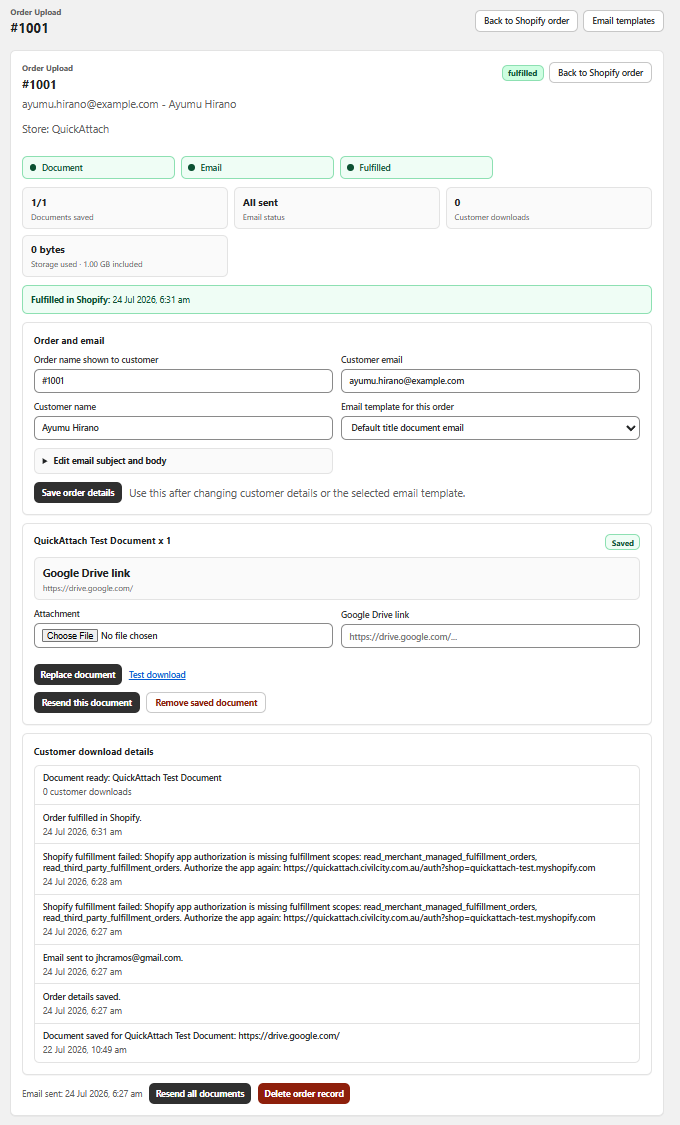
The finished file may not exist when the customer pays. Your team should be able to prepare the deliverable, return to the relevant order, and attach the file or secure link when it is ready.
2. Match the file to the order item
One order can contain several custom deliverables. The workflow should make the relationship visible so a report for one line item is not confused with a report for another.
3. Tell the customer what is ready
A useful delivery message identifies the order, explains what is available, and gives the customer one clear download action. If preparation takes time, the customer should not have to guess whether the order was forgotten.
4. Keep a path back to the file
Customers often need a document again later. An order-linked download path reduces the support loop created when the only copy was a loose attachment in an old email.
A practical comparison.
A product-level download workflow answers: “What file belongs to this product?” An order-specific workflow answers: “What deliverable belongs to this customer’s order?” Both questions are valid, but they solve different jobs.
For a standard digital product, product-level delivery is usually simpler. For personalised files, switching to an order-level workflow keeps the source of truth closer to the work your team is actually doing: preparing and fulfilling an individual order.
Read why product-level downloads fail custom orders for the underlying model. For a step-by-step setup, see how to deliver personalised digital products after purchase on Shopify.
Where QuickAttach fits.
QuickAttach is being built as the Shopify app for order-specific file delivery. A merchant can attach a file or secure link to the relevant order or line item, deliver it through a branded email when fulfillment is ready, and keep the customer download path associated with the order.
That makes it a candidate for stores selling made-to-order PDFs, astrology or tarot readings, certificates, proofs, audits, assessments, and private customer documents. QuickAttach is now live on the Shopify App Store.
Choose the workflow that matches your files.
If every customer gets a different deliverable, install QuickAttach for an order-specific Shopify file workflow.
Install on Shopify