Managing customer-specific files on Shopify is a workflow problem, not simply an upload problem. The file may not exist when the customer checks out. Your team creates or retrieves it afterwards, checks the customer details, and then needs to deliver the exact result to the correct person.
A product-level digital download is designed for a file that is the same for every buyer. For personalised reports, readings, certificates, proofs, assessments, and private documents, the order is the useful source of context.
Start with one source of order truth.
As soon as an order arrives, record the information your team needs to create the deliverable: the order number, customer name, purchased item, options, and any instructions. Keep the working file named or labelled so it can be matched back to that order without relying on memory.
This matters most when several customers buy the same service. “Final-report.pdf” is not an operational system. An order reference and a clear line-item match make a quick review possible before anything is sent.
Use a simple preparation-to-delivery workflow.
- Receive: review the paid order and the information needed to create the file.
- Prepare: create, check, and save the customer-specific deliverable.
- Match: confirm the file belongs to the correct order and line item.
- Attach: add the file or secure link to the order-linked workflow.
- Deliver: send the customer a clear branded download message when it is ready.
- Support: keep enough delivery context for the team to answer follow-up questions.
The final check is worth making explicit: compare the file’s customer details with the Shopify order before delivery. This small step addresses the most expensive failure mode—sending a private or personalised file to the wrong customer.
Why email and folders become fragile.
Email can be useful for collaboration, but it is a poor long-term delivery record. Attachments get forwarded, filenames are duplicated, and a support teammate may not know which message contains the final version. Shared folders have a similar problem: they store files, but do not automatically explain which order each file belongs to or whether it was delivered.
These gaps become larger when one order contains multiple custom deliverables. A report may be ready today while a certificate is still being prepared. The workflow should show those states clearly instead of forcing the merchant to reconstruct them from inboxes.
Where QuickAttach fits.
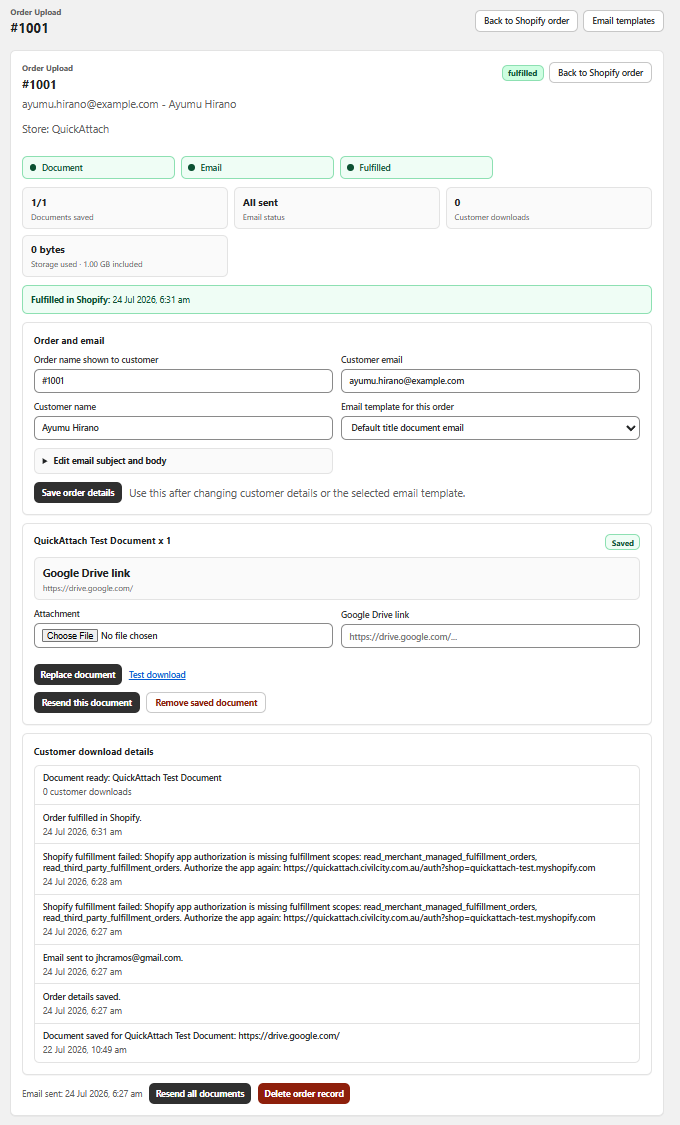
QuickAttach is being built around order-specific file delivery. A merchant can attach a different file or secure link to the relevant Shopify order item, then deliver it through a branded email when fulfillment is ready. The customer keeps an order-linked path to the deliverable, and the merchant keeps the delivery context with the order.
For the broader model, read how to deliver personalised digital products after purchase on Shopify. If you are handling more than one file, see how to manage made-to-order PDFs for multiple line items. QuickAttach is now available on Shopify App Store.
Keep every custom file with the order it belongs to.
Install QuickAttach for an order-specific Shopify file delivery workflow.
Install on Shopify