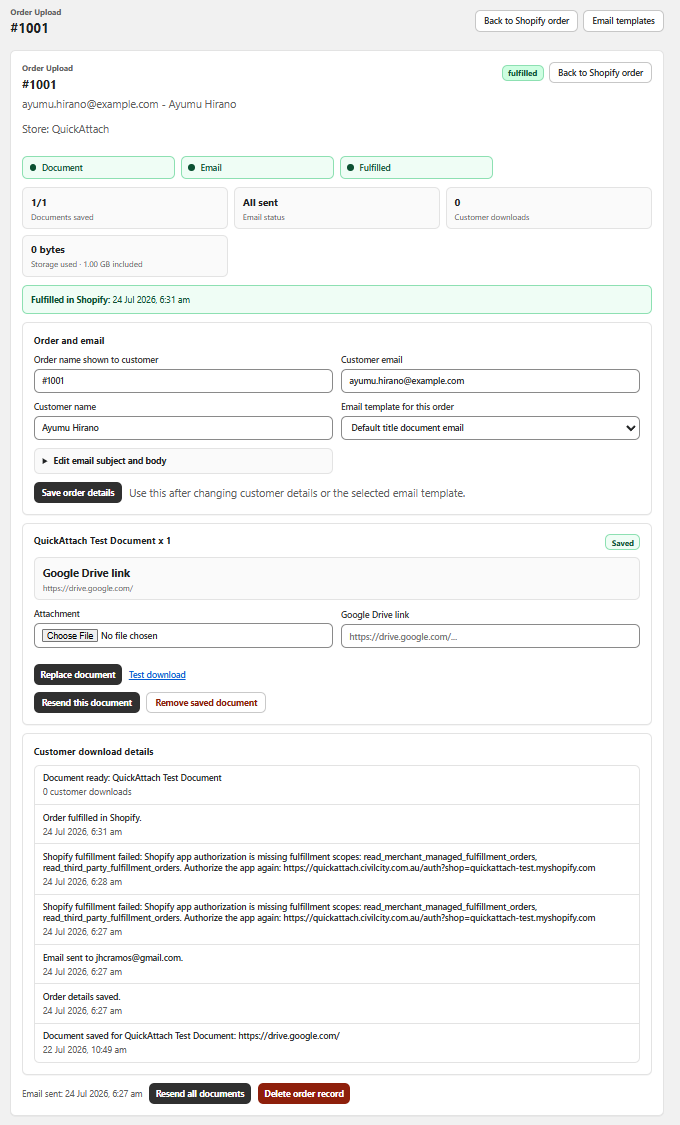
Most Shopify delivery guides assume the file is ready before the product is listed. You upload a PDF, the customer buys, and the app sends the download. Simple.
But when you sell personalized reports, certificates, proofs, readings, audits, or any file made for one specific customer, the file does not exist at checkout. The customer pays first. Your team creates the file. Then you deliver it. That delivery step is where most stores lose time and create risk.
The five steps of post-checkout file delivery.
Whether you use a tool, a manual process, or a mix of both, every post-checkout delivery follows the same five steps:
- Receive — The customer places and pays for the order. Shopify captures the order details.
- Prepare — Your team reviews the order, creates the file, and gets it ready for delivery.
- Attach — You connect the finished file to the specific Shopify order it belongs to.
- Deliver — The customer receives a branded email with a download link when the order is fulfilled.
- Re-download — The customer can return to the order-status page and download again without contacting support.
The gap for most merchants is steps three and four. You have the file, but Shopify has no built-in way to attach it to an individual order and send a branded download email.
How merchants deliver custom files today.
Most Shopify merchants handling custom deliverables use one of these methods:
- Email attachment. You finish the file, open your email client, and send it to the customer. The order has no delivery record. If the customer loses the file, support has to search inboxes to find what was sent.
- Cloud folder link. You upload the file to Google Drive, Dropbox, or a similar service, then paste the link into an email or order note. The download is disconnected from Shopify and the customer experience does not match your brand.
- Order notes or tags. You paste a link into the Shopify order notes field. There is a record on the order, but the customer has no self-service download and no branded delivery email.
- Product-level download app workaround. You create a hidden product variant for each order and upload the file there. This breaks your catalog, inventory, and reporting.
Each method separates the file from the order. The result is slower fulfillment, more support tickets, and no clean delivery record.
The problem with email attachment delivery.
Email is the most common method, and it is also the one that creates the most operational drag over time:
- The sent file is not connected to the Shopify order, so support has to leave Shopify to answer delivery questions.
- There is no branded download experience — the customer gets a loose attachment from a personal or team inbox.
- Email attachments can be blocked by spam filters or size limits, especially for large PDFs or high-resolution files.
- If the customer needs a new copy weeks later, they have to email support and wait for someone to find the file and resend it.
For a deeper look at why this breaks down, read why custom digital products need a post-checkout workflow.
What a clean delivery workflow looks like.
Instead of emailing files or pasting links into order notes, a clean post-checkout workflow keeps everything inside Shopify:
- After checkout, the order appears in your Shopify admin as usual. Your team reviews the order details and starts preparing the file.
- When the file is ready, you attach it to the specific order or line item it belongs to — not to the product, and not to a shared folder.
- At fulfillment, the customer receives a branded email with a clear download button. The email matches your store identity, not a personal inbox.
- After delivery, the file remains available from the customer's order-status page. If they lose the email, they can go back to the order and download again.
- For support, the Shopify order shows which file was attached, when it was delivered, and the delivery status. No searching inboxes.
A practical example: personalized report store.
Consider a store that sells personalized property reports. A customer places an order on Monday. Your team researches the property, compiles the report, and finishes the PDF by Wednesday.
With email delivery, you attach the PDF to an email and send it. The customer either saves it or loses it. If they lose it, they email support. Support searches the sent folder, finds the file, and resends it. Every step is manual.
With an order-specific workflow, you attach the finished PDF to the Monday order inside Shopify. When you mark the order as fulfilled, the customer gets a branded email with a download button. The file is also available from their order-status page. If they need it again next month, they go back to the order and download it themselves.
The difference is not just convenience. The order-specific workflow creates a delivery record, a branded experience, and a self-service re-download path — all connected to the Shopify order.
Files vs links: which to attach.
Some deliverables are files you upload directly. Others live in external systems — a Google Drive folder, a Dropbox link, a private URL, or a hosted report. A good post-checkout workflow should handle both:
- Direct file upload — Best for PDFs, spreadsheets, images, and documents you create and store locally.
- Secure external link — Best for files hosted in cloud systems, large deliverables, or files that are updated after delivery.
In both cases, the link or file should be attached to the Shopify order, not floating in an email. The customer should receive one branded email with one clear download action, regardless of whether the underlying file is uploaded or linked.
For more on this distinction, read how to attach a file to a specific Shopify order.
What to check before you ship a custom file.
Before marking an order as fulfilled and triggering the delivery email, confirm:
- The file matches the customer who placed the order — not a different customer with a similar name.
- The file is the final version, not a draft or working copy.
- The file name is clear and professional, not an internal code or temporary label.
- The order has the correct customer email address for delivery.
Sending the wrong file to the wrong customer is the most common — and most damaging — mistake in custom file delivery. A workflow that keeps the file attached to the order reduces this risk because you see the customer name, order details, and file in one place.
For more on preventing delivery mistakes, read why product-level downloads fail custom orders. When the file is ready, see how to send a digital file when a Shopify order is fulfilled. If you sell files prepared after payment, see the Shopify workflow for made-to-order digital products. If one file is ready before the rest of the order, read how to handle partial file delivery on Shopify.
Deliver custom files without leaving Shopify.
QuickAttach is being built to attach files or secure links to Shopify orders, send a branded download email at fulfillment, and keep a delivery record on the order for support. Install QuickAttach today.
Install on Shopify