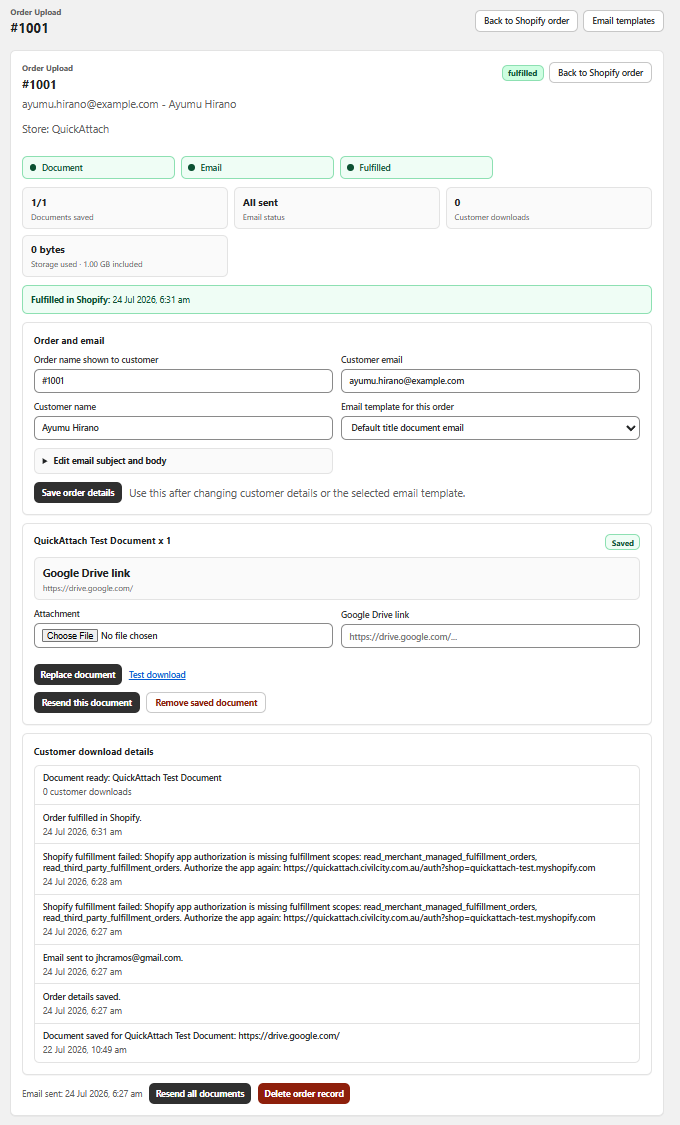
When a customer buys a personalized report, certificate, proof, assessment, or private document, the final file may not exist at checkout. That is normal. What is not normal is leaving the customer to guess whether the order was received, whether work has started, or when the file will arrive.
The best Shopify workflow separates payment confirmation from deliverable readiness. Tell the customer that the order is received, explain that the custom file is being prepared, and give them a clear place to return when it is ready.
Why silence creates avoidable support work.
A standard order confirmation says that a purchase was successful. It does not necessarily explain that the main value of the order will be created later. For a made-to-order digital product, that gap creates uncertainty.
- The customer may think the file was forgotten.
- Support has to look through email or folders for the latest status.
- A rushed team member may send an unfinished or incorrectly matched file.
- The merchant loses the connection between the delivery conversation and the Shopify order.
These problems get worse when several custom files are part of one order. Read how to handle partial file delivery on Shopify for that case.
Use three clear delivery states.
A useful customer message does not need a complicated status system. Three plain-language states cover most custom-file workflows:
1. Order received
Confirm the purchase and say what happens next. For example: “We have received your order. Your personalized report is now in our preparation queue.” This reassures the customer without pretending the deliverable is ready.
2. File being prepared
Explain that the file is created for this order after checkout. Include the expected next step or a realistic preparation window if the merchant can support one. Avoid promising an exact time that depends on manual work.
3. File ready
When the deliverable is checked, send the customer a branded download message with the order context and a direct path to the file. If they need it again later, the same order-linked path should remain useful.
Keep the status attached to the order.
The operational source of truth should be the Shopify order, not a personal inbox or a folder named with a customer surname. The team should be able to open the order and answer four questions:
- What did this customer buy?
- Which deliverable is being prepared?
- Is the file ready to send?
- What was delivered, and where can the customer download it again?
That is why order-level delivery matters. A product-level download assumes every buyer receives the same asset. A custom file belongs to the specific order or line item. See why product-level downloads fail custom orders for the distinction.
Write the pending message around the customer.
A good pending message is short, specific, and honest. It should include the order reference, the deliverable being prepared, what the customer needs to do next, and how they will receive the finished file.
For example:
We’re preparing your personalised report.
We’ve received order #1048 and are creating the report specifically for your details. There is nothing else you need to do right now. We’ll email you a branded download link when the file has been checked and is ready.
Do not attach a generic placeholder PDF just to make the order look complete. Do not call a file “ready” before someone has checked that it belongs to the correct customer. The message should reduce uncertainty, not disguise the workflow.
Where QuickAttach fits.
QuickAttach is being built around the gap between checkout and custom-file delivery. The merchant can keep the deliverable associated with the relevant Shopify order item, prepare it after purchase, and deliver it through a branded download workflow when it is ready.
That gives the customer a clearer journey: order received, file being prepared, file ready. It also gives the merchant and support team the order context needed to check delivery without reconstructing the history from separate tools.
Give customers a clear answer while the file is still in progress.
QuickAttach is accepting early-access signups for order-specific file delivery on Shopify.
Install on Shopify