What the public account establishes
The previously published QuickAttach story attributes the product to Urbix Group Pty Ltd and describes personalized tarot and astrology readings as the original operating context. It says QuickAttach began as an internal workflow before being offered to other merchants. The current app listing identifies Urbix Group Pty LTD as the developer.
This article revisits that public account. It is not a new founder interview, does not introduce private operating details, and makes no claim about order volume, revenue, support reduction, or measured results.
The requirement was a relationship
A standard service listing can be purchased more than once while producing different work every time. The reusable product description tells a buyer what they are ordering; it cannot identify the unique document that will be written afterward. That document needs a connection to its particular purchase.
The published story describes a need to distinguish pending and delivered work, present a recognizable delivery message, and help customers return to their files. Those are useful product requirements without assuming that all competing apps lack personalized delivery.
A fictional demonstration of the original problem
Two demo buyers purchase the same reflection-reading product. Order DEMO-520A receives a PDF about a fictional creative-project prompt; DEMO-520B receives a different PDF about a fictional learning goal. Both use the same storefront product, but their final files must stay separate.
| Requirement | Demonstration check |
|---|---|
| Correct association | Each order opens its own labeled demo file. |
| Visible readiness | An unfinished reading is not described as delivered. |
| Clear handoff | The message names the purchased service and download action. |
| Recovery | Support can locate the approved file from the order. |
This is a proposed demonstration, not a reconstruction of real customer records or a completed test.
What the lesson does and does not imply
The lesson is to model delivery around the work’s actual identity. It applies to readings, commissioned reports, and other outputs prepared after purchase. It does not prove that QuickAttach is the only app capable of the task: Fileflare and Uplinkly also document unique-order files.
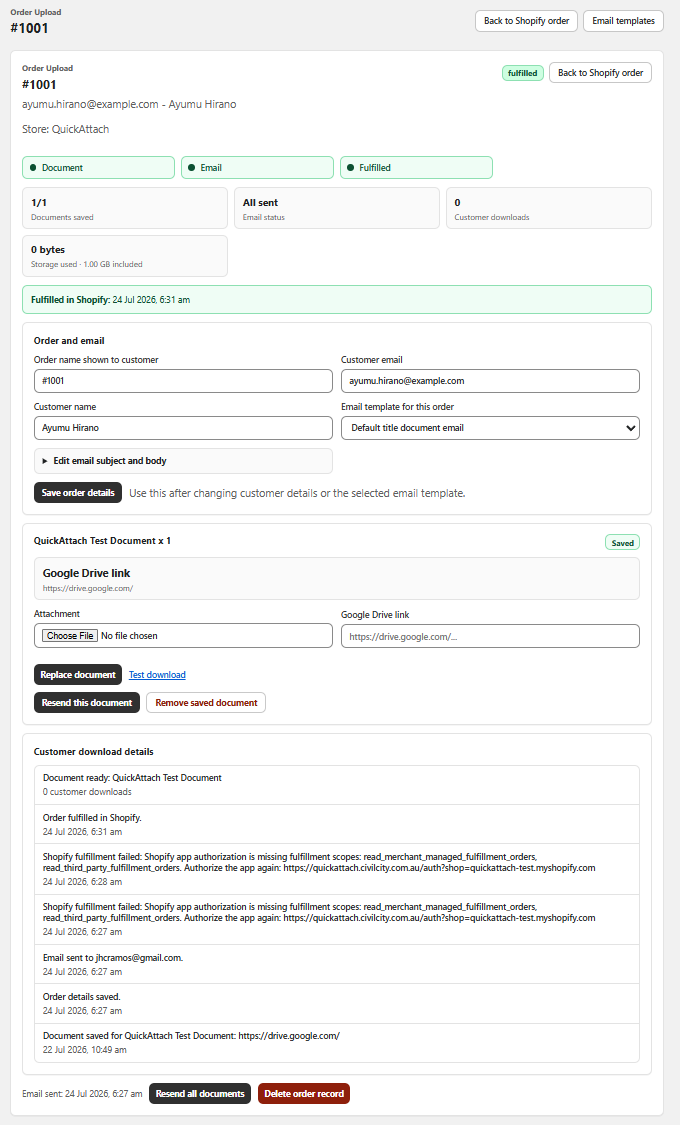
Today’s QuickAttach walkthrough presents the order-to-delivery sequence. Evaluate that sequence against your own work, including corrections and later access. The public origin explains why the product was built; the current documented workflow and a store-specific test should determine whether it fits your business.
Deliver the right file with the right order
See how QuickAttach connects a customer-specific file or link to a Shopify order item.
See the QuickAttach order-to-download walkthrough