This decision guide is published by QuickAttach. Its cost model uses explicit fictional inputs and does not present market rates or a tested savings claim.
Write the requirement that would justify a build
“We want a branded email” is different from “we need a specific audited approval chain across three systems.” List must-have behavior, evidence needed, and acceptable alternatives. First confirm whether candidate apps support the requirement; a missing button in a short trial is not conclusive evidence.
QuickAttach, Fileflare, and Uplinkly document personalized delivery. Their existence means an order-specific file requirement alone does not establish a need for custom software.
An editable annual cost model
App route = subscription + usage + external hosting
          + setup hours × internal hourly cost
          + annual operating hours × internal hourly cost

Build route = implementation + hosting + email/storage services
            + maintenance hours × engineering cost
            + support hours × operating cost
            + migration and exit provision
Use your own actual quotes and labor assumptions. Include the time spent verifying customer access and correcting wrong associations under both routes. Avoid counting app subscriptions as the entire app cost while counting every employee hour against the custom route.
A fictional sensitivity exercise
Suppose a shop estimates 20 setup hours for an app and 120 implementation hours for a custom service. Those are invented planning inputs, not market benchmarks. Recalculate with maintenance at two, five, and ten hours per month. If the decision reverses with a small change, the estimate is too uncertain for a confident commitment.
Also test a low-volume and a high-volume workload. A system that is cheap to operate for ten deliveries may require a different support arrangement when several staff handle exceptions every day.
Ownership checklist before approving development
- Who responds when links or emails stop working?
- Who updates the integration when platform requirements change?
- Who can restore files and delivery records?
- How are access, retention, and deletion implemented and verified?
- How does the business leave the system without losing customer continuity?
A custom solution needs a named maintainer, documentation, and a recovery plan even when the original developer leaves. An app still needs a merchant owner for source files, permissions, and customer support.
Prefer a small proof of the exceptional requirement before commissioning the full system. If a supported app passes the essential scenario, compare the remaining convenience gains against their continuing cost and responsibility.
Deliver the right file with the right order
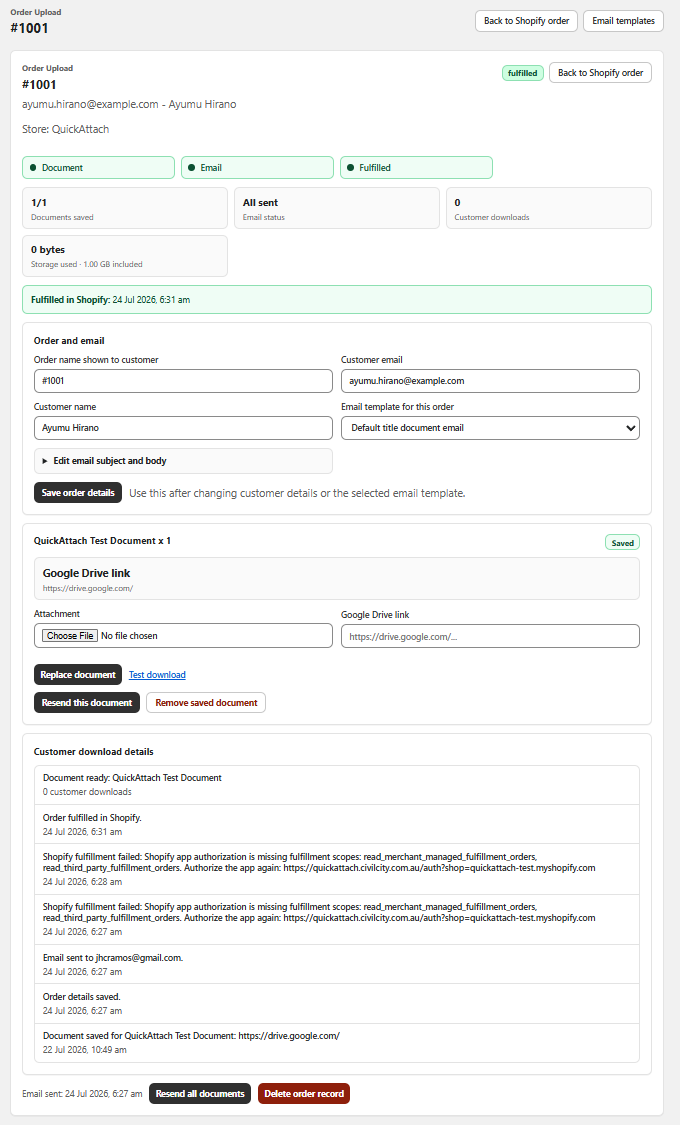
See how QuickAttach connects a customer-specific file or link to a Shopify order item.
Test QuickAttach with one sample order